What If Jamestown and Plymouth went the way of Roanoke?

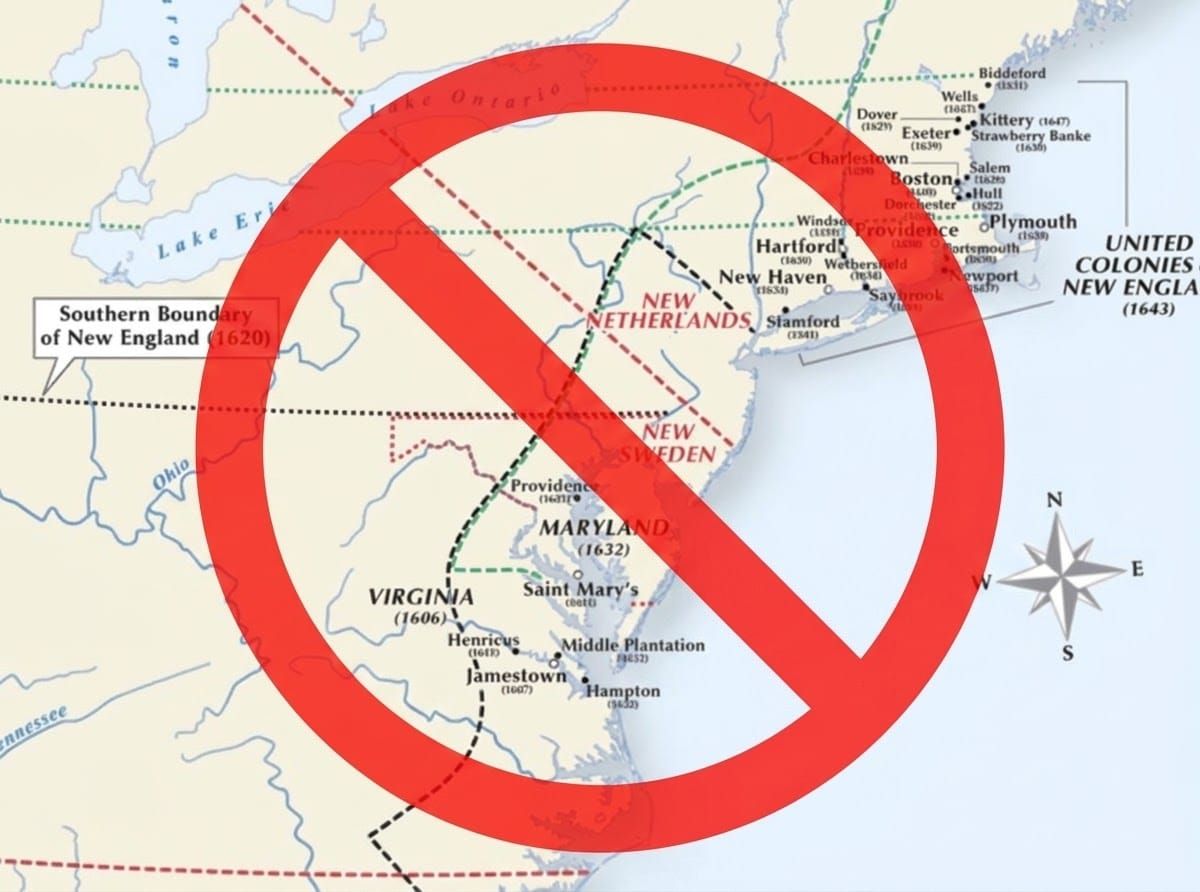
Ajacán Mission. Cuttyhunk. Roanoke. Popham. Cape Ann.
At the beginning of the 17th Century, the Northern Atlantic Seaboard seemingly lacked the resources that made other areas of the North American continent so inviting to European settlers. No gold or silver, not the right environment for sugarcane, no spices or cocoa. In 1624, after a string of failures, including the catastrophic collapse of the Plymouth Colony, King James I realized the foolhardiness of trying to colonize the eastern seaboard and turned his focus elsewhere. In the years that followed, the Native populations in what would never be called New England slowly recovered from the Great Dying of 1616-1619 and formed a confederation led by the Narragansett people.
Meanwhile, Spain, learning from its failure with the Ajacán Mission, slowly but steadily expanded northward from St. Augustine, anchoring its presence through a network of missions and coastal outposts across the territories of what we know as Georgia and South Carolina. France continued its exploration and trade exploitation of the interior, stretching from the St. Lawrence River to the Great Lakes, and down the Mississippi to New Orleans. The settlements of Fort Christina and New Amsterdam thrived without the pressure of English encroachment. With Native populations trading with France, Sweden, and the Dutch, they gained access to European goods over the next few decades. Due to smaller numbers of immigrants, European colonization (outside the Spanish sphere) likely looked more like what occurred in India, where colonies sprang up along the coast designed primarily to facilitate trade. Because of “friendlier” trade practices with Europeans and a slower wave of immigration (hopefully) lessening the impact of diseases like smallpox, Native American confederations such as the Narragansett, the Iroquois, and the Cherokee emerged as strong geopolitical actors in the area.
As England dealt with her own internal difficulties during the reign of Charles I, the English Civil War, and its aftermath, English involvement in North America was not a concern until at least after the restoration of the monarchy in 1660. At that point, England saw the Dutch prospering around the areas that the English had abandoned, while also seeing France expanding almost unchecked across the continent. England had to act both rapidly and pragmatically if she hoped to regain a foothold. A two-pronged policy of diplomacy and trade (much like her involvement in India) developed: trading posts along the Chesapeake, fortified harbors in Maine, commercial agreements negotiated with Native confederations, and diplomats seeking alliances with powerful nations such as the Iroquois to counter growing French influence.
Where does history go from here? I honestly feel like this counterfactual sets the stage for a much more violent version of the Seven Years' War in the opening decades of the 18th century, with England, France, the Dutch, the Swedes, Spain, and powerful Native confederations all competing for influence. Without the infrastructure of England's Thirteen Colonies, I see the war ending in a stalemate, with France retaining Canada and much of the interior, England holding its Chesapeake and Maine possessions, the Dutch and Swedes preserving their trading colonies, Spain retaining Florida and the Southwest, and the Iroquois, the Narragansett, and the Cherokee all emerging with increased territory, prestige, and formal recognition as sovereign powers. If that status quo held, and we had the eventual Revolutionary periods of our timeline, the North American continent of the 19th and 20th centuries would become a patchwork of nations, far more similar to Europe with its multiple competing states, shifting alliances, constantly recurring wars, and no single dominant power.