This Border State Showed-Me I Have Much To Learn About the American Civil War

I was recently assigned a project where I had to research a US state that was involved in the American Civil War and its impact on the war. I will freely admit that while I consider myself a lifelong student of history, I have never really delved into the ACW (my areas of interest have always been ancient history, medieval Europe, the American Revolution and WW2). Most of my forays into that conflict have been courtesy of alternate history. Novels like Bring The Jubilee, The Impeachment of Abraham Lincoln, and Harry Turtledove’s Southern Victory series all detail how the world may have changed if the ACW and its aftermath had ended differently. So I have to admit that most of my “knowledge” of that period has been informed more by ‘What If?’ than by actual academic study. So for this assignment, when I was looking at the map, I found it really interesting that Missouri was a Union state. I always assumed that Missouri was a Slave state. Which it was! I just never realized that Missouri, Kentucky, Maryland and Delaware were all slave states that stayed with the Union during the Civil War.
The land that would become the state of Missouri was purchased from the French in 1803 as part of the Louisiana Purchase and officially recognized as part of the Louisiana Territory in 1805. After Louisiana was granted statehood in 1812, the land was renamed the Missouri Territory. In 1820, when Missouri petitioned for statehood, Northern politicians, fearing the shift in Senate power from a tie to a 24-22 advantage for slave states, balked. A compromise was reached in which Maine’s petition would also be granted, maintaining equilibrium; and a provision was added that banned slavery from all the remaining land of the Louisiana Purchase north of the 36° 30' parallel. The Compromise was controversial at the time as it just kicked the can down the road to the Compromise of 1850, the Kansas-Nebraska Act in 1854, and ultimately the 1857 Supreme Court decision in Dred Scott v. Sandford. Missouri had a direct tie to the latter two events. After the Kansas-Nebraska Act was passed, thousands of pro-slavery Missourians crossed the border into Kansas to illegally cast ballots for pro-slavery candidates. In 1846, Dred Scott, and his wife Harriet filed suit in the St. Louis Circuit Court, asking for their freedom because they had resided in the free state of Illinois and the Wisconsin territories. The Supreme Court ultimately ruled that no Black person, regardless of their status as free or enslaved, could be an American citizen or sue in federal court; and that Congress had no power to ban slavery in federal territories, which struck down the Missouri Compromise of 1820.
Because of its control over the Mississippi and Missouri Rivers, Missouri was strategically important in the ACW. Although Governor Claiborne Fox Jackson was a vocal proponent of secession, the Missouri State Convention decided by a landslide margin to remain loyal to the Union. In response, Jackson organized a pro-Confederate administration-in-exile, and the Union established a local provisional government led by Hamilton Gamble. Gamble had been the Chief Justice of the Missouri Supreme Court and had written a dissent to the decision that had denied the Scotts their freedom.
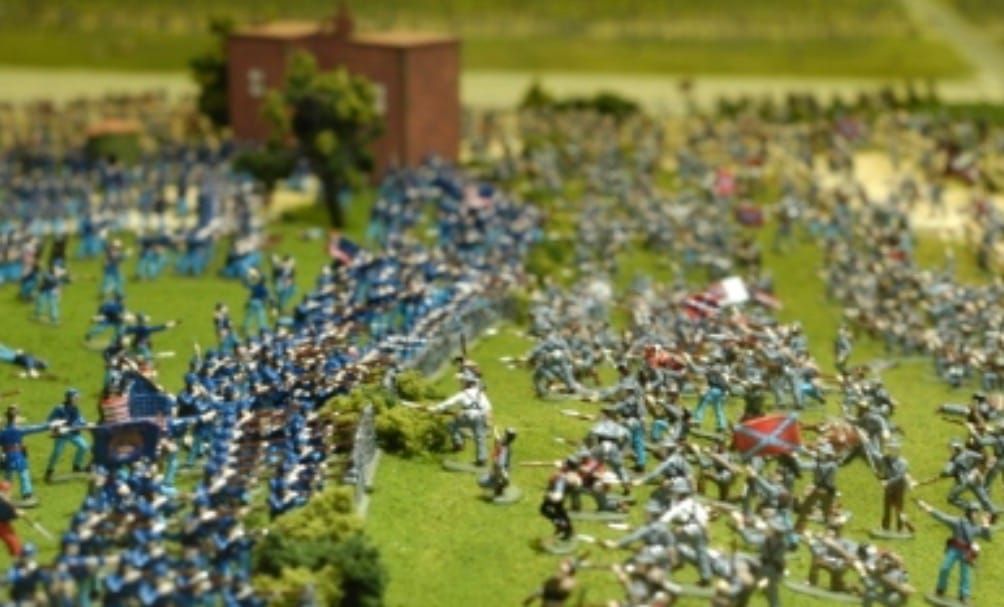
Missouri was the setting for a number of notable battles during the ACW: the Camp Jackson Affair (1861), Battle of Wilson’s Creek (1861), Price’s Raid (1864), and the Battle of Westport (1864), which is often referred to as the “Gettysburg of the West.”
My learning experience with Missouri has shown me that the American Civil War cannot be understood simply as a conflict between a free North and a slaveholding South. Missouri was one of four slave states that remained in the Union, the state fielded soldiers for both sides, endured rival governments, and played a direct role in the political and legal disputes that drove the nation toward war. Its history exposes the complicated loyalties and contradictions that are easily lost when the era is reduced to a map colored blue and gray. I began this assignment surprised to find Missouri on the Union side of that map; I leave it realizing how much more I have to learn about the American Civil War. In that respect, the Show-Me State has lived up to its name.