Religion. Boy, I Don’t Know

For a recent assignment I had to write an essay answering what do the Salem Witch Trials and the Great Awakening say about the role of religion in the English Colonies and ultimately the role of religion in America now?
~~~~~~~~~~~~~~~~~~~~~~~~~~~~~~~~~~~~~~
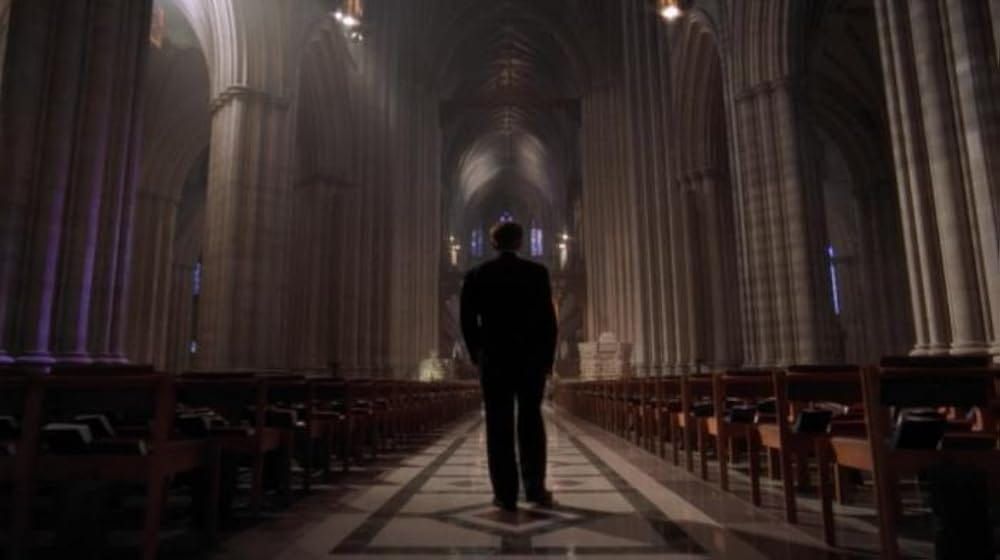
To snowclone a famous line from the television series The West Wing: “Religion. Boy, I don’t know (Graves & Sorkin, 2002).” Arguably, religion was, and is, on its own, a perfectly wonderful thing. Religion can help one have faith, give moral guidance, help with your relationship with family and the world. It can help you celebrate and grieve. It is only when religion is shaped, manipulated and twisted by immoral people or governments that it becomes an issue.
Last semester I took a religion class that forced me to re-evaluate my relationship with religion. I grew up in a very Catholic household. We went to church every Saturday, I went to catechism class every Sunday, and enthusiastically took the sacraments of confession and communion. In my early teens, I actually wanted to be a priest, I would hold mass for my stuffed animals. And then I had a crisis of faith that I have never recovered from. A close friend passed away in the 10th grade and I couldn’t wrap my head around it. To use Jonathan Edwards’ (1741/2019) words: “And it would be no wonder if some person that now sits here in some seat of this meeting house in health, and quiet and secure, should be there [in hell] before tomorrow morning.” Or to quote The West Wing again, when President Bartlett suffers the loss of a trusted friend and confidante: “‘You can’t conceive, nor can I, the appalling strangeness of the mercy of God,’ says Graham Greene. I don’t know whose ass he was kissing there ’cause I think you’re just vindictive (Schlamme & Sorkin, 2001).” I couldn’t believe in a God that could take someone so suddenly and for no reason. Religion no longer served a purpose for me.
Religion in the English Colonies was a pervasive and powerful force that shaped community dynamics, the legal system, and individual psychology. It relied on both fear and strict moral frameworks. In Salem in the 1690’s, the area was experiencing an influx of refugees fleeing the fallout of King William's War, and dealing with a widening economic rift between those who depended on agriculture and those who profited off the activities in the Port of Salem (Blumberg, 2022). Add to this a religious figure who was known for his greedy and rigid nature and you have the recipe for disaster. Though it would still be almost fifty years until Edwards (1741/2019) uses terrifying imagery to frighten his followers: "the God that holds you over the pit of hell, much as one holds a spider, or some loathsome insect, over the fire, abhors you, and is dreadfully provoked (para. 3)", one can only wonder if such spiritual dehumanization had already taken root in the Salem community? It’s probably far easier to accuse someone of being a witch or the tool of the devil if they are seen as a spider or insect, especially if the person comparing them to that is a religious figure ostensibly speaking for God?
Fast forward a few decades, and religion in the colonies underwent a massive cultural upheaval during the age of the Great Awakening. While ministers like Edwards (1741/2019) utilized fear, using quotes like “nothing but his [God’s] hand that holds you from falling into the fire [of hell] every moment (para. 3)” to induce spiritual compliance, the landscape of faith shifted as itinerant revivalists skirted traditional, state-sanctioned pulpits to lead vast open-air assemblies. This movement eroded the dominance of long-standing Puritan and Anglican institutions, making way for the rise of egalitarian sects. Groups like the Baptists and Methodists flourished, championing a revolutionary spiritual parity that ignored social standing, ethnicity, or material prosperity. It was this questioning of organized religion that made questioning the King in the coming decades that much easier. Edwards even unintentionally prophesizes this with his line: “You have offended him infinitely more than ever a stubborn rebel did his prince.” Also, in a rhetorical move that will only gather strength in the ensuing centuries, Edwards (1741/2019) purposefully twists a quote from the Bible to further his agenda, claiming: “God will be so far from pitying you when you cry to him, that ’tis said he will only laugh and mock (Proverbs 1:25-32) (para. 5).” The actual context of those lines in the Bible are the personification of Wisdom speaking. Wisdom will mock and laugh, not God.
As to what this means today? We live in a society that can draw serious parallels to Salem and how religion is used to control. Much like the citizens of Salem were taught to fear the refugees, we are being falsely told by our government and media to fear immigration. The economic rift of Salem between the haves (Salem’s port families) and the have-nots (agricultural families) is nothing compared to the economic disparity that we have today. But instead of being jealous or envious of the billionaires, we are supposed to fear immigrants?
Returning to my opening argument, religion can be a wonderful tool for good, but it can also be a weapon for evil. We have seen a number of examples in the last few months of the word of God being misinterpreted or outright fabricated to further political ends. Our current Secretary of Defense is a prime example of this. Secretary Hegseth has been invoking religion in an attempt to reshape our armed forces, going so far as to reciting a prayer that incorporated the iconic, fictionalized Ezekiel 25:17 monologue made famous by Samuel L. Jackson in the 1994 film Pulp Fiction.
With thousands of verses to pull from the Bible, it can be quite easy to find the perfect one to shape one’s ideological pursuit. As a perfect example, if one needs a proactive participation, they can quote Matthew 12:30 (New International Version, 1978/2011): “Whoever is not with me is against me.” If one wants a more passive participation, one can quote from Mark 9:40: “for whoever is not against us is for us.” I think the best argument against quoting the Bible, is to quote the Bible. Again, from The West Wing, President Bartlett takes down a right-wing radio personality by asking her rhetorically (among many other examples): “I wanted to sell my youngest daughter into slavery, as sanctioned in Exodus 21:7. She's a Georgetown Sophomore, speaks fluent Italian, always cleared the table when it was her turn. What would a good price for her be (Graves & Sorkin, 2000)?”
While the Bible offers thousands of passages to draw from, we can see that the historical record cautions us that when we cherry-pick our own version of the truth, we are no longer using religion for good, we are simply forcing it to serve our own agenda. In the end, my personal exodus from religion highlights a recurring historical tragedy. If we permit the peddlers of absolute certainty to weaponize faith, whether it is to purge a community of its “unwelcome” neighbors or to overhaul the armed forces, we are effectively trading away the possibility of true spiritual mercy in favor of totalitarianism.
References Cited
Blumberg, J. (2022, October 24). A Brief History of the Salem Witch Trials. Smithsonian Magazine. https://www.smithsonianmag.com/history/a-brief-history-of-the-salem-witch-trials-175162489/
Edwards, J. (2019). Jonathan Edwards Revives Enfield, Connecticut, 1741. In J. Locke & B. Wright (Eds.), The American Yawp reader. Stanford University Press. https://www.americanyawp.com/reader/colonial-society/jonathan-edwards-revives-northampton-massachusetts-1741/ (Original work published 1741)
Graves, A. (Director), & Sorkin, A. (Writer). (2000, October 18). The Midterms (Season 2, Episode 3) [TV series episode]. In A. Sorkin, T. Schlamme, & J. Wells (Executive Producers), The West Wing. Warner Bros. Television.
Graves, A. (Director), & Sorkin, A. (Writer). (2002, May 22). Posse Comitatus (Season 3, Episode 22) [TV series episode]. In A. Sorkin, T. Schlamme, & J. Wells (Executive Producers), The West Wing. Warner Bros. Television.
Holy Bible: New International Version. (2011). Bible Gateway. https://www.biblegateway.com/passage/?search=Matthew%2012%3A30&version=NIV (Original work published 1978)
Schlamme, T. (Director), & Sorkin, A. (Writer). (2001, May 16). Two cathedrals (Season 2, Episode 22) [TV series episode]. In A. Sorkin, T. Schlamme, & J. Wells (Executive Producers), The West Wing. Warner Bros. Television.