Reimagining Lithuania
Assume that all you know about Lithuania is its external boundaries, the size of the population, and the physical geography. Nothing else exists. Now invent everything else. Make up the cities, decide where the people are located. This was both a creative and an analytical assignment.


Intro To Geography Assignment:
Assume that all you know are the nation's external boundaries, the size of the population, and the physical geography. Nothing else exists. You invent everything else. You make up the cities. You decide where the people are located. This is both a creative and an analytical assignment. You are making a series of maps and providing explanations for the placement of each item.
In the world of grand strategy games like Sid Meier’s Civilization or Europa Universalis, every decision is a calculation of risk and geography. You learn quickly that centralization is a vulnerability. If your entire economy or defense is anchored to a single "tile," you are one disaster away from a game over. When I looked at Lithuania, a nation historically defined by its proximity to Russia, Poland, and Prussia, I couldn’t help but view its map through that same lens of strategic systems. If I were to "rebuild" this nation, I wouldn't just build it for prosperity; I’d build it for survival. My goal would be to create a layered system of redundancies so deep that no single "decapitation strike" could ever bring the country to its knees.
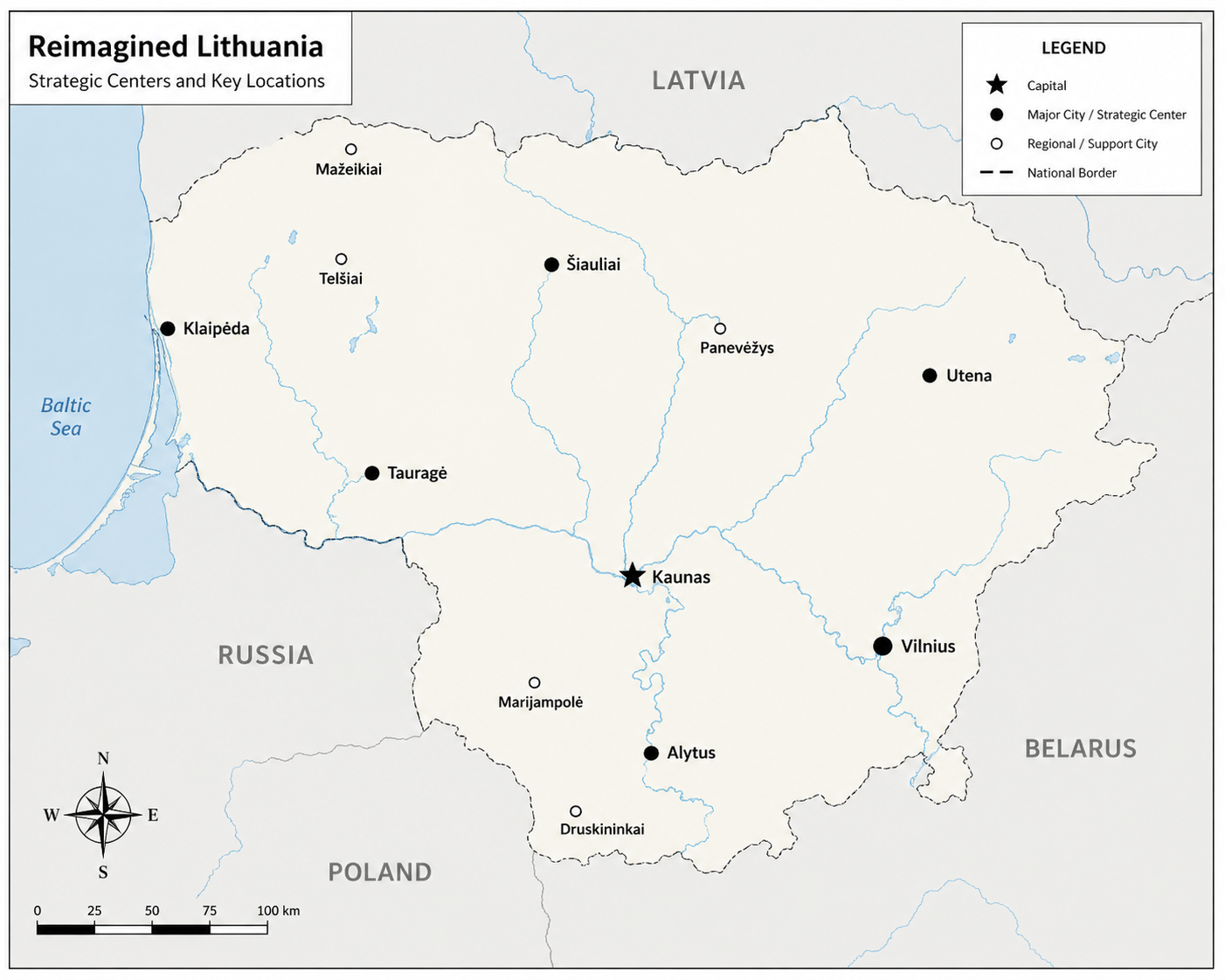
I’d start by putting the capital further east than it is in reality. Assuming that my version of Lithuania is going to grow over time as opposed to me building it Minecraft style, the perfect place would be where the city of Kaunas is today. Located at the juncture of a few rivers, the capital would have taken advantage of river transportation in the pre-industrial period. Centrally located, it is also pushed back from the borders with surrounding nations.
Another great geographic location is where the current city of Taurage is. Located at a confluence of rivers and a closer proximity to the Baltic Sea, it would mean that any city placed there would evolve from an early trading center into the country’s financial capital.
As I mentioned above, Lithuania’s greatest threat is invasion from Russia and Belarus. For the purpose of this rebuild, I’m going to assume Lithuania and Latvia share the same political relationship they have in our history. In the early years of my imagined scenario, Lithuania would have had army bases dotted along the borders she shared with Russia/Belarus and Prussia/Poland/Germany. After World War 2 and the evolution of warfare from infantry-centric to a more multifaceted strategic endeavour, I’d pull the main army bases back, putting them close to the urban centers of Vilnius, Utena, and Alytus. The main air base would be further west and north, closer to Latvia, just outside Siauliai. Lithuania would have no need for a deep seas fleet, but would still need a small coastal defense fleet. I would place this base near where the current city of Klaipeda is. From here, the navy would be able to defend the entirety of Lithuania’s 60 mile coastline.
Knowing that you can’t build a strong military without a strong industrial structure, I would mirror the industrial pivot Lithuania executed after declaring independence from the USSR. I’d shift away from the legacy communist model of centralized heavy industry, opting instead for a distributed, high tech manufacturing landscape. Rather than concentrating production in a singular hub, I would scatter specialized sectors across the map to leverage regional advantages: Klaipėda for maritime commerce, Kaunas for machinery and logistics, and smaller municipalities for niche production. The west coast would blend together maritime industries to support both the coastal navy and the aquaculture industries, aquaculture for food production, and import/export. The area around Taurage would focus on both import/export, the financial industries and biotech. Siauliai would be home to the military aspects around the aerospace defence of the country. Alytus would be the industrial center for agriculture processing.
Just like in the real world, I wouldn’t want my version of Lithuania to have to depend on her potential rival for her energy needs. Since leaving the USSR, Lithuania has worked towards achieving energy independence from Russia and currently imports liquid natural gas from the West. I would focus on a varied and redundant mix of energy to be as energy independent as possible. Lithuania has a very small domestic oil production along its west coast on the Baltic and a refinery in Mažeikiai. I would keep these both while also focusing on renewable energy across the nation. Offshore wind in the Baltic Sea and wind farms in the hilly lands in the eastern part of the nation both make logistical sense. Additionally, I would prioritize solar across the country. One of the conditions of Lithuania joining the EU was to decommission its sole nuclear reactor (the same flawed design used in Chernobyl) but in my world, I would focus on building a Western style nuclear reactor somewhere along the northern coast of the Baltic Sea. The key for my nation would be to have a varied portfolio of energy so that if Russia (or another bad actor) wanted to cause disruptions, there would be a fallback option.
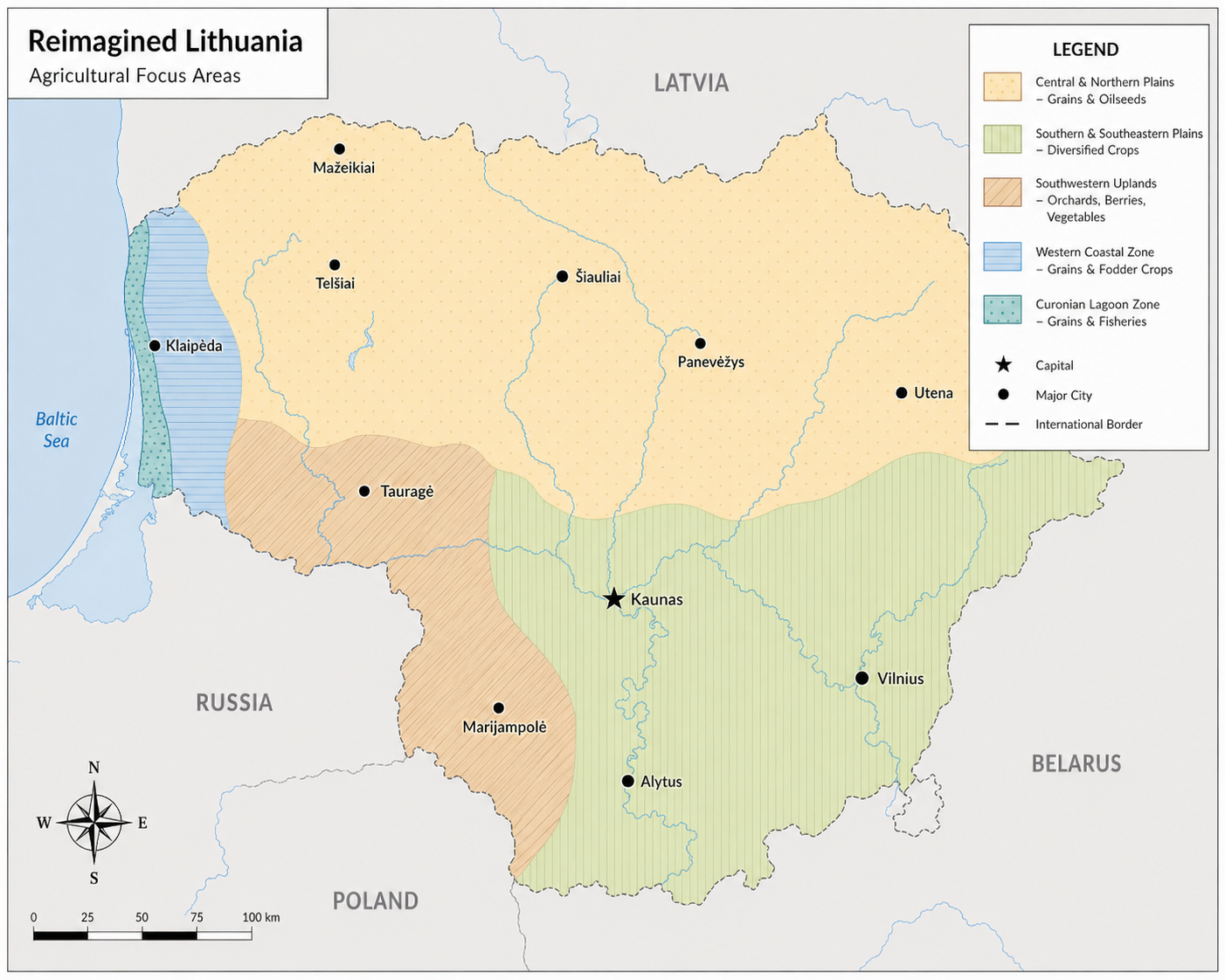
Much like my strategy for defense and energy, I'd want Lithuania's agricultural sector to lean into its natural strengths and focus on food independence. For my reimagined nation, I would utilize the central and northern plains for broad-acre farming of grains and oilseeds, while focusing on the western regions to support livestock, dairy, and fodder crops. In the south and southeast, I'd prioritize smaller-scale, diversified agriculture like orchards, berries, and vegetables to ensure a robust and independent specialized food network. I was disappointed to learn that the Baltic Sea is not a great fishing environment for Lithuania due to overfishing of cod in previous years and the brackish waters. I would balance conservation efforts (as noted below) with developing aquaculture in the Curonian Lagoon.
We’re not building Lithuania just for today, but for a bright future, so I would establish a rigorous land-use framework that partitions the territory into strict preserves, working forests, restoration zones, and managed recreation areas, ensuring that every acre of the map serves a deliberate purpose. Sensitive coastal regions like the Curonian Spit (which separates the Baltic Sea and the Curonian Lagoon) would be tightly protected from the threat of overdevelopment, while agricultural buffer zones and urban green belts would mitigate environmental decay and unchecked sprawl. The objective is to engineer a landscape that isn't merely productive, but one designed for long-term sustainability and strategic resilience. Interestingly, in my research for this, I came across mention that strategically managed wetlands could serve the same defensive purpose as mountains by slowing down tanks and mechanized infantry.
As much as I tried to make her self-sufficient, Lithuania cannot exist in a vacuum, so I would structure Lithuania’s trade network around multiple redundant hubs rather than a single dominant center, ensuring resilience. Klaipeda, being the major port, would serve as the external gateway for maritime imports and exports, with Taurage handling the administration of that gateway. Kaunas would anchor the domestic distribution as well as serving as the land connection to Poland and the rest of the EU. Siauliai would serve the same purpose to Latvia and Estonia. The key is a layered system that avoids bottlenecks or invites a single decapitating strike and that keeps trade flowing even under pressure.
Finally, none of these redundancies work if we can’t move materials, men, or machinery around the country, so I would Railroad Tycoon the heck out of Lithuania, creating high speed rail connections between all the major cities we have discussed. I would ensure multiple tracks ran on the Klaipeda to Taurage to Kaunas to Vilnius artery, both for redundancy and to facilitate both freight and passenger rail between those four cities. Additionally, I would ensure that multiple rail routes existed to both Latvia and Poland, tying the country tightly to both its closest ally to the north and to the EU. I would also create modern expressways connecting all the cities to one another. On the routes to Vilnius, Utena, and Alytus, and the roads connecting Poland and Latvia to the nation, I would ensure that the roads could handle the heavy toll of military traffic. Finally, I would lean into the riverways that Lithuania already has and work to connect some of the rivers by canal, most notably between the Levwo and Nevetis rivers, and the Venta and Dubsya rivers.
I feel my reimagined Lithuania would be able to stand on its own, at least initially, against any Russian style aggression mirroring the Ukraine conflict. By leaning into a distributed model that scatters political, economic, and military power across the map, I've ensured the nation avoids any singular point that could invite a decapitation strike. Every system within this thought exercise: defense, trade, energy, and agriculture is designed with layered redundancies to maintain continuity and flexibility. In the end, I think I have engineered a nation that would endure and adapt to the dangerous world of being a former part of the Soviet Union.